Category: Special Events

Sports stadia, large-scale and special event AV production.

  • Behind the scenes: AV production for the UEFA Under-19 Championship Finals Draw

    A finals draw for a UEFA tournament is live, international, and unforgiving. There is no second take. It was one of the highest-profile pieces of event production Wrexham had seen, and the venue we were asked to do it in was a lecture theatre at Wrexham University, a room never designed for an event of that scale.

    This is the story of how it came together, and why the most important work happened on a drawing weeks before anyone walked in.

    How we got the job

    Wrexham University brought me in. I used to lecture there in audio engineering, so I still have good contacts in the building. The head of the university’s AV team felt the specification was larger than he was comfortable taking on alone, and asked me to get involved early.

    The brief was substantial: a large video LED wall, custom branding, audio, live streaming, and lighting. The Football Association of Wales was running the event on behalf of UEFA. This was not a job to wing.

    The problem the room handed us

    The lecture theatre had a catch. The lectern, where the presenter would stand, was off to one side of the space. There was not enough room to place the video screen behind it in the conventional position.

    On camera, that would have looked wrong. And this event was going out live to an international audience, so wrong on camera was not an option.

    The thing is, I knew about it weeks before the day, because I was working in CAD. I could see the whole room to scale on screen, and the problem was obvious in the design long before it could become a problem in the room.

    The fix came from the design

    Because I could see it early, I could solve it early. I amended the CAD plan to include a branded set panel return positioned behind the presenter, framing the video wall properly so the whole thing read correctly on camera as well as in the room.

    That solution only exists because of the design process. Spotting the issue on a drawing meant we could build the answer in before anything was installed, rather than discovering it on the morning with no time to fix it.

    We presented the amended design to the FAW, who were running the event for UEFA. They liked it. A phone call followed, the quote was discussed and agreed, and the job was confirmed. This is exactly what AV system design is for.

    On-site technical lead, not just a supplier

    Once it was confirmed, we had direct technical conversations with UEFA, who in turn liaised with the other external suppliers responsible for the live stream and the live graphics.

    That made PSL the on-site technical lead. We supported the other companies, connected everything together, and acted as the intermediary between the two external suppliers so that UEFA’s own technical provision, the live stream, and the venue infrastructure all spoke to each other. In my own words, we brought all the technical provision together, supplied some of the tech, and enabled the rest to integrate.

    That is a different level of responsibility from turning up with a PA. We were the point where everything met.

    How the day went

    Once everything was agreed, the day itself was straightforward, which is exactly how you want a live international broadcast to feel. The draw went out live, internationally, without a hitch. I thought it looked great, and I genuinely enjoyed working with everyone involved, not least seeing how other companies operate at that level.

    The part I remember most is the relationship side. Building instant rapport so that clients trust you and feel in good hands is half the job on an event like this. The UEFA contacts may not come round often, but the relationship with the Welsh FA is one I would very much like to continue.

    It is a fair summary of how we work: get the hard thinking done early, on the drawing, so the day takes care of itself.

    Frequently asked questions

    What did PSL do for the UEFA Under-19 Finals Draw?

    We were the on-site technical lead, supplying the production and connecting it together. We brought the technical provision together, supplied some of the tech, and enabled the other external suppliers, including the live stream team, to integrate.

    How did the CAD design help?

    The lectern was off to one side, leaving no space for the screen behind it. Working in CAD, we spotted this early and added a branded set panel return behind the presenter so it looked correct on camera.

    Was the event live-streamed?

    Yes, internationally, from a lecture theatre at Wrexham University not designed for an event of that scale. It went out live without a hitch.

    Who ran the event?

    The Football Association of Wales ran it on behalf of UEFA. PSL was brought in early by Wrexham University and worked directly with UEFA and the external suppliers.

    Planning a high-stakes event in North Wales?

    If a job has to go right the first time, in front of an audience or a camera, the work that makes that happen starts long before the day. We do conference AV and large-scale event production across North Wales and the wider UK.

    Get in touch and we will talk through what your event needs.

    Darren Hughes is Director of Pivotal Sound & Lighting, an AV and event production company based in Llay, Wrexham, North Wales. PSL delivered the technical production for the UEFA Under-19 European Championship Finals Draw and works with clients including Rolex, Google, and the Football Association of Wales.
  • What we learned from delivering AV production for the UEFA Under-19 Finals Draw

    Delivering the AV production for the UEFA Under-19 Championship Finals Draw was one of the proudest jobs we have done. It went out live, internationally, without a hitch. But the more useful thing to share is not the result, it is what the job confirmed about how good events actually get made. We told the full story separately in our behind the scenes of the UEFA Under-19 Finals Draw. These are the event production lessons we took away from it.

    Lesson one: the day is won on the drawing

    The single biggest takeaway is that the hard work happens weeks before anyone walks in.

    The venue, a lecture theatre at Wrexham University, had the lectern off to one side, with no room to place the video screen behind it conventionally. On camera, that would have looked wrong. Because we were working in CAD, we spotted it weeks out and designed a branded set panel return to fix it before anything was built. Had we found that on the day, there would have been no time to solve it. The lesson is simple: design early, and the day takes care of itself.

    Lesson two: being the technical lead is about coordination

    We were not just a supplier on this job, we were the on-site technical lead. That is a different kind of responsibility, and it taught us a lot.

    We had direct technical conversations with UEFA, who liaised with the external companies handling the live stream and the live graphics. Our role was to connect everything, support those other companies, and act as the bridge between them so that every system spoke to each other. The kit matters, but on a job like this, coordination is the real skill. Being the calm point where everything meets is what keeps a complex event from falling apart.

    Lesson three: working with good people raises your game

    One of the genuine pleasures of the job was seeing how other top companies operate, and working alongside them.

    You learn from that. Being in a room with skilled suppliers, all pulling in the same direction on a live international broadcast, sharpens how you work. It is a reminder that the best events are collaborative, and that there is always something to take from people who are excellent at what they do.

    Lesson four: rapport is part of the technical job

    The part I remember most is not a piece of equipment, it is the relationships. Building instant rapport so clients trust you and feel in good hands is half the job on an event like this.

    On a high-pressure day, a client needs to know the technical team has it handled, so they can get on with their own job. That trust is not a soft extra, it is what makes the whole thing run smoothly. And it is what turns a single event into an ongoing relationship. The connection with the Football Association of Wales is one we would very much like to continue.

    Why this matters for any event

    None of these lessons are unique to a UEFA draw. Design early so problems are caught on paper. Coordinate your suppliers properly. Be honest about budget and brief. Build trust with the people you work with. Those four things make an international broadcast succeed, and they make a one-day conference succeed too. The scale changes. The principles do not.

    Frequently asked questions

    What is the biggest lesson from a high-stakes live event?

    That the work which makes it succeed happens long before the day. Designing the room in CAD weeks ahead caught a problem that would have looked wrong on camera.

    What does it mean to be the on-site technical lead?

    Being the point where everything meets: supplying production, connecting external suppliers, and making sure the live stream, the venue, and the client’s teams all work together.

    Why does relationship-building matter in event production?

    Because clients need to trust the technical team completely on a high-pressure day. Building rapport is half the job, and it turns a one-off into an ongoing relationship.

    Do these lessons apply to smaller events?

    Yes. Designing early, coordinating suppliers, and being honest about budget make any event run better.

    Planning a major event in North Wales?

    We deliver special events production and high-stakes live events across North Wales and the wider UK, with the design-led, coordinated approach these jobs demand.

    Get in touch and we will talk through what your event needs.

    Darren Hughes is Director of Pivotal Sound & Lighting, an AV and event production company based in Llay, Wrexham, North Wales. PSL was the on-site technical lead for the UEFA Under-19 European Championship Finals Draw and delivers major events for clients including Rolex, Google, and the Football Association of Wales.

  • Sports presentation AV: what separates a great matchday atmosphere from a mediocre one

    Two grounds can have the same crowd, the same fixture, and the same weather, and feel completely different. One crackles with energy from the moment the gates open. The other feels flat no matter what happens on the pitch. The difference is very often the sports presentation AV, and most of it comes down to details the crowd never consciously notices.

    Here is what actually separates a great matchday atmosphere from a mediocre one.

    Coverage: everyone has to hear it

    The first thing is simple to say and easy to get wrong. The PA has to be clear everywhere in the ground, not just near the speakers.

    A great atmosphere needs every fan to hear the announcer and feel the music, whether they are behind the goal or in the far corner. If half the ground gets a muddy, delayed version of the audio, you have lost half the crowd from the energy. Proper coverage, designed for the actual shape of the ground, is the foundation everything else sits on.

    Timing: the moment is everything

    This is the part that genuinely separates the good from the forgettable. Atmosphere is built on timing, and timing has to be exact.

    We run music and walkout tracks from show-control software, so the right track fires at exactly the right moment, every single time. A walkout that lands a beat late, a goal celebration track that fumbles for a second, a sting that comes in after the moment has passed, each of those quietly drains the energy out of something that should lift the whole ground. When the timing is tight, the crowd feels it even if they could never tell you why.

    For the full picture of how this runs week to week, see our piece on matchday AV management.

    Ducking: announcements that always cut through

    A great matchday sound system handles the awkward overlap between music and the spoken word automatically.

    We set the announcer’s microphone and the scoreboard feed to duck the music, so the instant someone speaks or a clip plays, the music drops underneath, then comes back up afterwards. No one is scrambling for a fader. The result is that announcements and safety messages always come through cleanly, the music never fights them, and the whole thing sounds polished and intentional. Where a mediocre setup has the announcer shouting over the music, a great one makes the handover seamless.

    Lights and screens lift the big moments

    Sound builds the base, but the visual side is what turns key moments into spectacle.

    An LED video wall is the best tool for this, carrying content, replays, sponsor moments, and crowd engagement. Lighting adds energy to the moments that deserve it. We have seen exactly how much this matters running a full fanzone for a season, with a stage, a PA, moving head lights, a flown truss, and an LED wall, all working together to make the space feel like an event rather than a car park with speakers.

    Reliability is the quiet hero

    The last thing is the one nobody thinks about until it fails. A great matchday system is reliable, week in and week out, because there is no second take at a live fixture.

    That comes from specifying the system properly, keeping it simple enough to be bulletproof, and having people who know the ground running it. A clever system that falls over once a season is worse than a simple one that never does. Consistency is its own kind of atmosphere.

    Frequently asked questions

    What is sports presentation AV?

    The audio, video, and lighting that creates atmosphere at a sporting event: the PA, the announcer, walkout and goal music, screen content, and the timing that ties it all together.

    What separates great matchday atmosphere from mediocre?

    Coverage, timing, and reliability. Clear PA everywhere, music and announcements hitting at the right moment, and automatic ducking so announcements always cut through.

    How does music timing affect the atmosphere?

    Hugely. We run tracks from show-control software so the right track fires at the right moment, every time. A late walkout takes the energy out of the moment.

    Do you upgrade matchday sound for clubs?

    Yes, from matchday support to upgrading a ground’s audio infrastructure entirely, across Wales and the UK.

    Running a club or stadium in Wales?

    We provide special events and sports production and matchday AV for clubs and stadia across Wales and the wider UK, built to make your ground feel like the event it should be.

    Get in touch and we will talk through your matchday.

    Darren Hughes is Director of Pivotal Sound & Lighting, an AV and event production company based in Llay, Wrexham, North Wales. PSL delivers sports presentation AV and matchday production for clubs and venues across Wales and the UK, including ongoing work at Wrexham AFC.

  • Large-scale event production: how to manage AV for 2,000+ attendees

    Running AV for a few hundred people and running it for a few thousand are not the same job scaled up. They are different jobs. Once you cross into the thousands, with multiple stages and zones all running at once, the challenge stops being about equipment and becomes about coordination.

    We have done this work at real scale, from Wales Comic Con to a production for around 2,000 children. Here is how managing AV for a large event actually works.

    Scale changes the whole problem

    At a small event, you have one stage, one system, one focus. At a large event, you might have several stages live at the same time, in different rooms or zones, each needing its own sound, its own content, and its own crew, while none of them are allowed to bleed into each other.

    That is a planning problem before it is a technical one. The kit is the easy part. Mapping out what runs where, when, and who manages it, so the whole site works as one event rather than several competing ones, is the real work.

    A real example: Wales Comic Con

    We worked with Wales Comic Con for several years as the event grew, across Wrexham and the international event at Telford. It is a good illustration of multi-stage production, because there was no single setup, there were several at once.

    There was a gaming stage with its own LED video wall. There were two separate Q&A stages: a smaller one, roughly eight metres by four, built with pipe and drape, a PA, and wireless microphones, sitting right in the main expo hall, and a larger theatre space as well. Each of those is its own little production, and they all had to run simultaneously without stepping on each other.

    The lesson from a job like that is that consistency and coordination matter more than raw power. Every stage has to be reliable, every changeover has to be planned, and the whole thing has to hold together for the length of the event.

    Use what is already there

    A smart part of large-event production is not bringing everything from scratch. At the larger Comic Con theatre space, the in-house stage set and line array were already in place, so we supplied our own wireless microphones and lighting to complete it.

    That is the efficient way to work at scale. You assess what the venue already provides, then add exactly what is missing, rather than duplicating equipment and cost. On a big multi-zone event, that judgement keeps the production both better and leaner.

    Scale also means crowd, not just kit

    Big numbers bring their own considerations beyond the stages. We delivered a high-energy production for around 2,000 children at the Cheshire Scouts Chamboree, and a crowd that size changes how you think about coverage, about safety announcements, and about making sure everyone, everywhere, is part of the event.

    For outdoor large-scale work specifically, the weather, power, and access planning matter even more, which we cover in our piece on outdoor event production. Indoors or out, the principle holds: at scale, the planning is the product.

    Frequently asked questions

    What makes large-scale event AV different?

    Scale changes the problem from running one stage to running several at once, often in different zones, without them interfering. It becomes as much about coordination and crowd flow as about equipment.

    How do you handle multiple stages at one event?

    Each stage is its own system with its own PA, microphones, and content, planned so they do not clash. At Wales Comic Con we ran a gaming stage with an LED video wall alongside two separate Q&A stages.

    Can you supply AV for an event with 2,000 people?

    Yes. We delivered a high-energy production for around 2,000 children at the Cheshire Scouts Chamboree, and multi-stage AV for Wales Comic Con across several years.

    Do you work with a venue’s existing equipment at large events?

    Often, yes. At one Comic Con theatre the in-house stage and line array were already in place, so we supplied our own wireless mics and lighting.

    Planning a large-scale event in North Wales?

    We deliver special events production and multi-stage AV for large events across North Wales and the wider UK, with the planning and coordination that scale demands.

    Get in touch and we will help you map it out.

    Darren Hughes is Director of Pivotal Sound & Lighting, an AV and event production company based in Llay, Wrexham, North Wales. PSL has delivered large-scale, multi-stage events including Wales Comic Con and major youth productions across the UK.

  • Fan zones and outdoor sports events: the AV challenges nobody talks about

    Fan zone AV looks, from the outside, like a party. Behind the scenes, it is one of the more demanding outdoor AV jobs you can take on, because it has to be fun, loud, weatherproof, and able to go silent and serious in an instant if there is a safety announcement.

    We ran a full fan zone for a season, so this is not theory. Here are the challenges that nobody talks about until they are standing in a marquee with a crowd building outside.

    What a fan zone actually needs

    When we ran ours, the setup gives you a sense of the scope. There was a stage in the corner of a marquee, a full PA, moving head lights, face lighting on a flown lighting truss, an LED video wall for content, and a safety announcement system that could override everything.

    That is a complete production, outdoors, in a temporary structure, built to run for an extended period and take whatever the weather and the crowd throw at it. None of it is the same as setting up indoors for a seated audience.

    The thing nobody mentions: safety announcements

    Here is the challenge that does not make it into the glossy photos. In a packed fan zone, a safety announcement has to cut through everything, instantly, with no margin for error.

    So we built an automatic ducking system for exactly that. The moment a safety announcement is made, the music drops underneath it on its own, with zero manual intervention required. Nobody has to find a fader or remember a procedure in the middle of a busy event. The system handles it every single time.

    That is non-negotiable in a crowd environment. The fun stuff, the music and the lights, is what people remember, but the safety system is the part that has to be perfect, and it is the part a serious production company obsesses over.

    Outdoors makes everything harder

    A fan zone is an outdoor event, and outdoor brings its own well-known challenges, all of which apply here.

    The rig has to be weatherproof, because a British event can be hot and sunny one hour and wet the next. The sound has to carry across an open space and through a moving crowd, not a seated room. Power and access have to be planned from the start. These are the same fundamentals as any outdoor sports event production, just concentrated into a space designed to hold a lot of excited people in one place.

    It connects to the matchday picture

    A fan zone does not exist in isolation, it is part of the wider event-day experience around a fixture. The same thinking that makes a matchday inside the ground feel professional, clear coverage, tight timing, and automatic ducking, is exactly what makes a fan zone work outside it.

    When the fan zone and the matchday production share that standard, the whole day feels seamless to a fan, from the moment they arrive to the final whistle. That is the goal, and it is the kind of work I would happily do more of.

    Frequently asked questions

    What AV does a fan zone need?

    Typically a stage, a full PA, lighting, and an LED video wall for content, plus a safety announcement system that can override everything instantly.

    What is the biggest challenge with fan zone AV?

    Safety announcements. In a packed outdoor crowd, an emergency message has to cut through the music instantly. We build automatic ducking so it drops the music on its own.

    How is outdoor sports AV different from indoor?

    Weather, power, and coverage all become harder. The rig has to be weatherproof, the sound has to carry across open space, and the layout has to account for a moving crowd.

    Have you run a fan zone before?

    Yes, for a season, with a stage in a marquee, a full PA, moving head lights, a flown truss, an LED video wall, and an automatic safety announcement system.

    Planning a fan zone or outdoor sports event in Wales?

    We deliver special events production and fan zone AV across Wales and the wider UK, built for the weather, the crowd, and the moments that matter.

    Get in touch and we will talk through what your event needs.

    Darren Hughes is Director of Pivotal Sound & Lighting, an AV and event production company based in Llay, Wrexham, North Wales. PSL has run full fan zone production and delivers sports and outdoor event AV across Wales and the UK.

  • What makes an awards ceremony feel like an event rather than a meeting?

    We have all been to an awards do that felt like a long dinner with some certificates handed out, and we have all been to one that felt genuinely exciting. The room is often the same. The difference is the awards ceremony AV, and specifically a few choices that turn a sit-down meal into an event.

    Here is what actually makes an awards ceremony feel like an occasion, and how to get there at any budget.

    Audio: be heard over a room that is having fun

    The first job at an awards night is the hardest to fake. The audio has to be clear and loud, but never deafening, and it has to win against a room that is determined to chat.

    Awards are evening events, usually with food and drink, which means the audience gets vocal as the night goes on. That is part of the fun, but it means every single word spoken on stage has to carry clearly over the noise of the room. If the audience at the back cannot hear the winner’s name, the moment is lost. Getting that balance right, present and intelligible without being painful, is a real skill.

    The other audio detail people forget is the walk-on stings, the music that plays as someone goes up. Those have to be planned in advance, cued and ready, not improvised on the night. A fumbled sting deflates the very moment it is supposed to lift.

    Lighting: this is where the energy comes from

    If audio makes the night work, lighting makes it feel like a celebration. The key ingredient is flashy lighting for the walk-up stings, as presenters and winners approach and leave the stage.

    That burst of light and movement is what signals: this is a moment, pay attention. An awards night without it feels flat, however good everything else is. Lighting is the difference between someone shuffling up to collect a trophy and someone walking out to an entrance. It costs surprisingly little to do well, and it transforms the feel of the whole evening.

    Video and set: three options, all of which look the part

    The big visual backdrop is what frames the stage, and there is a strong option at every budget. We tend to think of it in three tiers.

    The best result is an LED video wall. It is bright, flexible, and looks superb, and it gives you a dynamic backdrop for branding, nominee content, and winner reveals.

    If a video wall is beyond the budget, a custom set is an excellent alternative that still looks bespoke and considered. And if a custom set is beyond reach too, our package set with a projector and staging still looks fantastic. The point I always make to clients is that there is no budget at which an awards night has to look cheap. There is a right answer at every level.

    This kind of tiered, design-led thinking runs through all our work, and it is closely related to how we approach AV design for conferences.

    Frequently asked questions

    What makes an awards ceremony feel special?

    Clear audio that carries over a lively room, lighting that marks each walk-up and walk-off moment, and strong visuals on screen or a set.

    Why is audio so important at an awards night?

    Evening events with food and drink mean the audience becomes vocal. Every word on stage has to be heard clearly, loud but not deafening, with walk-on stings planned in advance.

    Do you need an LED video wall for an awards ceremony?

    It is the best option, but not the only one. A custom set is a great alternative, and our package set with a projector and staging still looks fantastic.

    What does awards lighting do?

    It creates the energy. Flashy walk-up stings as presenters and winners approach the stage make an awards night feel like a celebration.

    Planning an awards ceremony in North Wales?

    We deliver special events production and awards ceremony AV across North Wales, Chester, and the wider UK, with an option that looks the part at every budget.

    Get in touch and we will help you make your night feel like an event.

    Darren Hughes is Director of Pivotal Sound & Lighting, an AV and event production company based in Llay, Wrexham, North Wales. PSL delivers awards ceremonies, conferences, and live events across the region and the wider UK.

  • What does matchday AV management actually involve?

    What does matchday AV management actually involve?

    When Ryan Reynolds and Rob McElhenney took over Wrexham AFC, they held a press conference in the middle of the stands, and then went out to speak to the fans on the pitch. We provided the audio for that moment. The cameras and the broadcast were other people’s job. The sound of the new owners addressing the club for the first time was ours.

    That is the visible end of matchday AV management in Wales, the bit that makes the news. But most of what matchday AV management involves happens every other week, with no cameras around, and it is worth understanding what actually goes into it.

    Matchday AV is live event production, every week

    A football matchday is a live event with a fixed kick-off and no second take. The crowd arrives, the announcements have to land, the music has to hit at the right moment, and the safety messages have to be heard by everyone, clearly, no matter what else is going on.

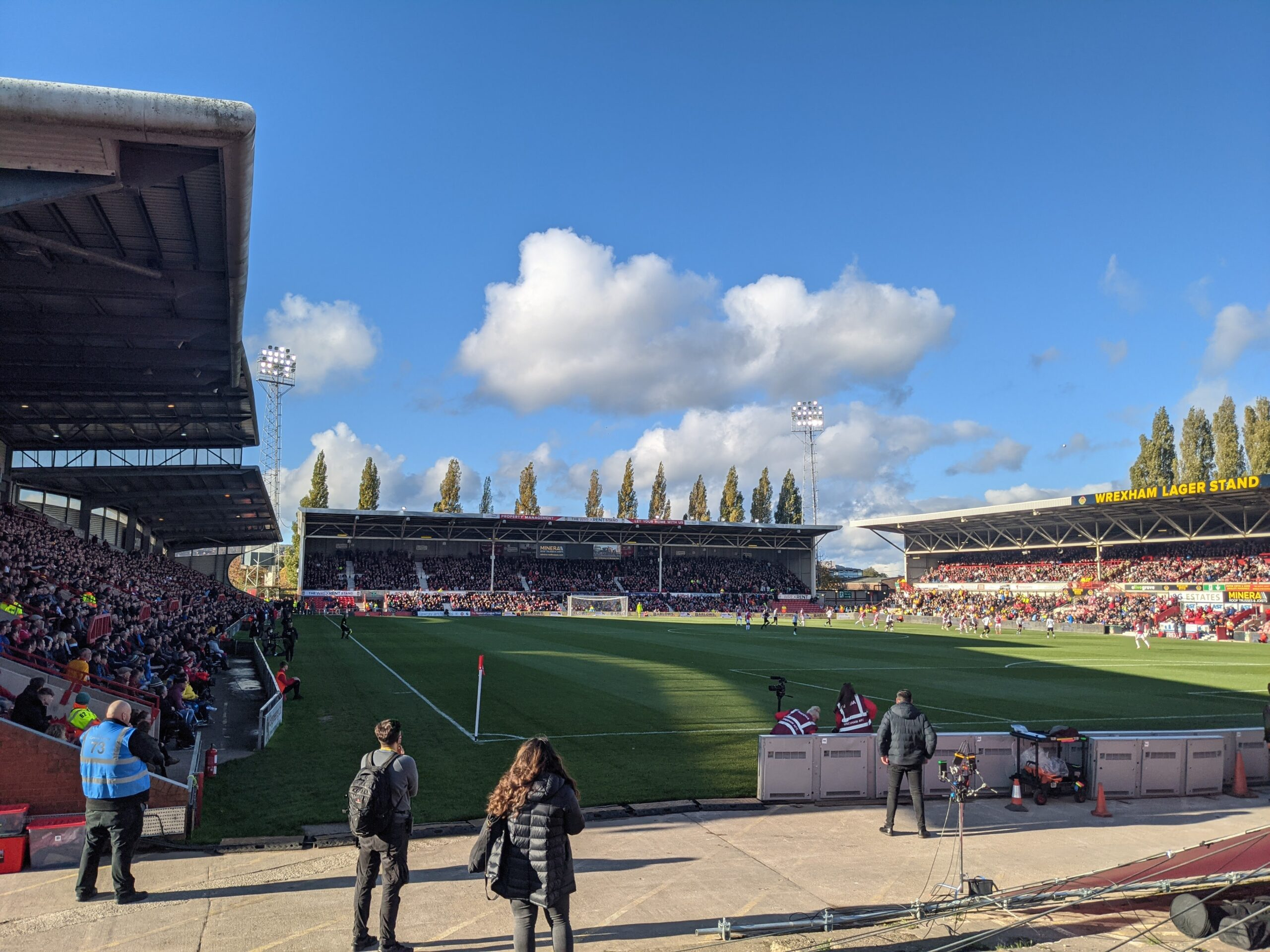
    Our relationship with Wrexham AFC goes back a long way, and it predates PSL itself. Years ago, when the stadium had been under-invested in, I was looking after its audio infrastructure. For a long time after that, we carried out the annual audio safety checks on the ground, making sure the system was safe to use.

    After the takeover, everything accelerated. We were brought in for the early events: the press conferences, the talks on the pitch, and the international fixtures, where we work alongside the AV company brought in by the visiting football association. Today we provide technical support at every home match.

    What we run on a matchday

    The kit list for a matchday is smaller than people expect, because the skill is not in the amount of equipment, it is in how reliably it all works together.

    At the heart of it is an Allen & Heath SQ mixer. The announcer uses a JTS UF-20 wireless microphone. Music and walkout tracks run from a MacBook using QLab, which is show-control software that fires the right track at the right moment with no fumbling for a play button. The scoreboard feed comes into the same desk, so anything playing on the screen is part of the same mix.

    None of that is exotic. What makes it work is that it has been specified to do one job extremely well, week in and week out.

    The clever bit: ducking

    Here is the detail that separates a polished matchday from a messy one. Both the announcer’s microphone and the scoreboard feed automatically duck the music.

    Ducking means that the moment the announcer speaks, or the scoreboard plays an advert or a clip, the music drops underneath it on its own. No one has to reach for a fader. When the announcement finishes, the music comes back up. It happens automatically, every time.

    It sounds small, but it is the difference between a stadium that sounds professional and one where the announcer is fighting the music for the crowd’s attention. When ducking is set up properly, the audience never notices it, which is exactly the point.

    The same principle covers the most important audio of all: safety announcements. They have to cut through instantly and clearly, with no manual intervention required, and the system is built so they always do.

    It takes a person who knows the ground

    Equipment does not run a matchday. People do. Cerys is PSL’s technical lead on most matchday operations, and she knows that ground and that routine inside out.

    That familiarity matters more than any single piece of kit. Someone who knows where every cable runs, what the announcer needs, and how the day flows will keep a matchday running smoothly in a way that no spec sheet can capture.

    From safety checks to a UEFA tournament

    The work has grown a long way from those early audio safety checks. For one season we ran the full fanzone at the Racecourse: a stage in the corner of a marquee, a full PA, moving head lights, a flown lighting truss, an LED video wall for content, and an automatic ducking system for safety announcements so nothing was ever left to chance. The fanzone paused when the new stand began construction, and I hope they bring it back.

    We have also provided AV for the club’s conferences and town hall meetings, the smaller-set, projector-and-audio end of the work. And in summer 2026, we are the AV supplier at the Racecourse Stadium for the UEFA Under-19 European Championship finals matches being held in Wales.

    Looking back at where the relationship started, the simplest way I can put it is this: we’ve grown together.

    If you run a club or a venue and you are thinking about your own special events and sports production, the same principles apply at every level. For more on the atmosphere side specifically, see our piece on sports presentation AV.

    Frequently asked questions

    What does matchday AV management involve?

    The stadium PA, the announcer’s microphone, walkout and goal music, and the audio feed from the scoreboard, all mixed live so announcements, adverts, and music never fight each other. It also includes the safety announcement system, which must be clear and reliable at all times.

    What is audio ducking on a matchday?

    Ducking automatically lowers the music when the announcer speaks or when the scoreboard plays a clip. We set both the wireless mic and the scoreboard feed to duck the music with no manual intervention.

    What equipment runs a football club matchday?

    Our setup uses an Allen & Heath SQ mixer, a JTS UF-20 wireless announcer microphone, and a MacBook running QLab for music and walkout tracks, with the scoreboard feed routed in and automatic ducking across the whole system.

    Do you provide AV for sports events across Wales?

    Yes. We provide matchday AV, sports presentation, and event production for clubs and stadia across Wales and the wider UK.

    Running a club or stadium in Wales?

    Whether you need matchday support, a ground PA that actually works, or production for a one-off fixture, we have done it at the highest level a club in Wales can ask for. Get in touch and we will talk through what your matchday needs.

    Darren Hughes is Director of Pivotal Sound & Lighting, an AV and event production company based in Llay, Wrexham, North Wales. PSL provides matchday AV, sports presentation, and event production for clubs and venues across Wales and the UK, including ongoing technical support at Wrexham AFC’s Racecourse Stadium.